



Picture two businesses with the same website traffic. One turns two visitors in a hundred into customers; the other turns four. Same ad spend, same audience, same number of clicks — and one makes twice the revenue. The difference is not luck. It is conversion rate optimization, and it is one of the most overlooked levers a business has.
Most companies pour money into getting more people to the site and almost none into helping those people act once they arrive. This guide explains what CRO is, why it usually beats buying more traffic, and a practical, repeatable process you can use to lift conversions — whether the goal is a sale, a booking or an enquiry.
What Conversion Rate Optimization Is
Conversion rate optimization is the systematic process of increasing the share of visitors who complete a desired action. Your conversion rate is simply that share — if 1,000 people visit and 30 buy, you are converting at 3 percent.
A “conversion” is whatever matters to your business: a purchase, a form submission, a phone call, a quote request, a newsletter sign-up. The crucial word is systematic. CRO is not a designer’s hunch about a nicer button. It is research, hypotheses and testing, repeated until the wins compound.
Why CRO Beats Chasing More Traffic
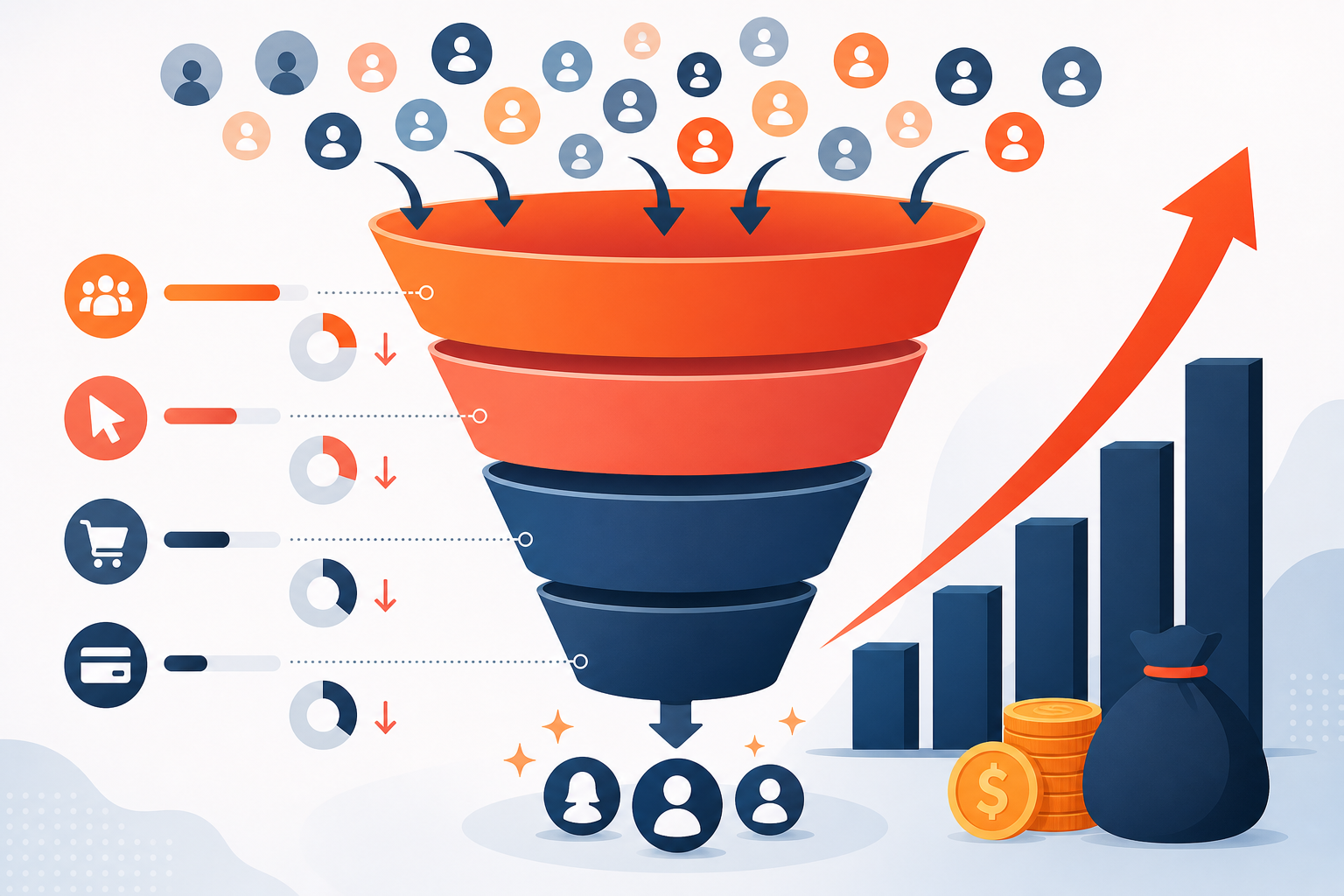
Here is the maths that makes CRO so attractive. Say you get 10,000 visitors a month and convert at 2 percent — that is 200 customers. Doubling your traffic to 20,000 (expensive and slow) gets you to 400. But lifting your conversion rate to 4 percent gets you to the same 400 from your existing traffic — no extra ad spend required.
The leverage is real, which is why CRO is consistently described as one of the highest-return marketing activities. Research from the field repeatedly finds that the average company invests far less in conversion optimization than in driving traffic, leaving easy gains on the table (CXL, 2023). CRO also stacks with everything else: better conversion makes your SEO and ads more profitable because each visitor is worth more.
The CRO Process: A Repeatable Loop
Good CRO is a loop, not a one-off redesign. The cycle looks like this:
- Research. Combine quantitative data (analytics, funnels, heatmaps) with qualitative insight (surveys, session recordings, customer interviews) to find where and why people drop off.
- Hypothesise. Turn a finding into a testable statement: “Because visitors abandon at the shipping-cost surprise, showing delivery costs earlier will reduce checkout drop-off.”
- Prioritise. You cannot test everything. Rank ideas by likely impact, confidence and effort so you tackle the big, easy wins first.
- Test. Run a controlled experiment — usually an A/B test — to measure the change against the original.
- Learn and repeat. Whether it wins or loses, you have learned something about your customers. Feed that back into the next round.
The discipline is what separates CRO from guesswork. Each cycle makes you a little less wrong about what your visitors actually want.
A/B Testing Without Fooling Yourself
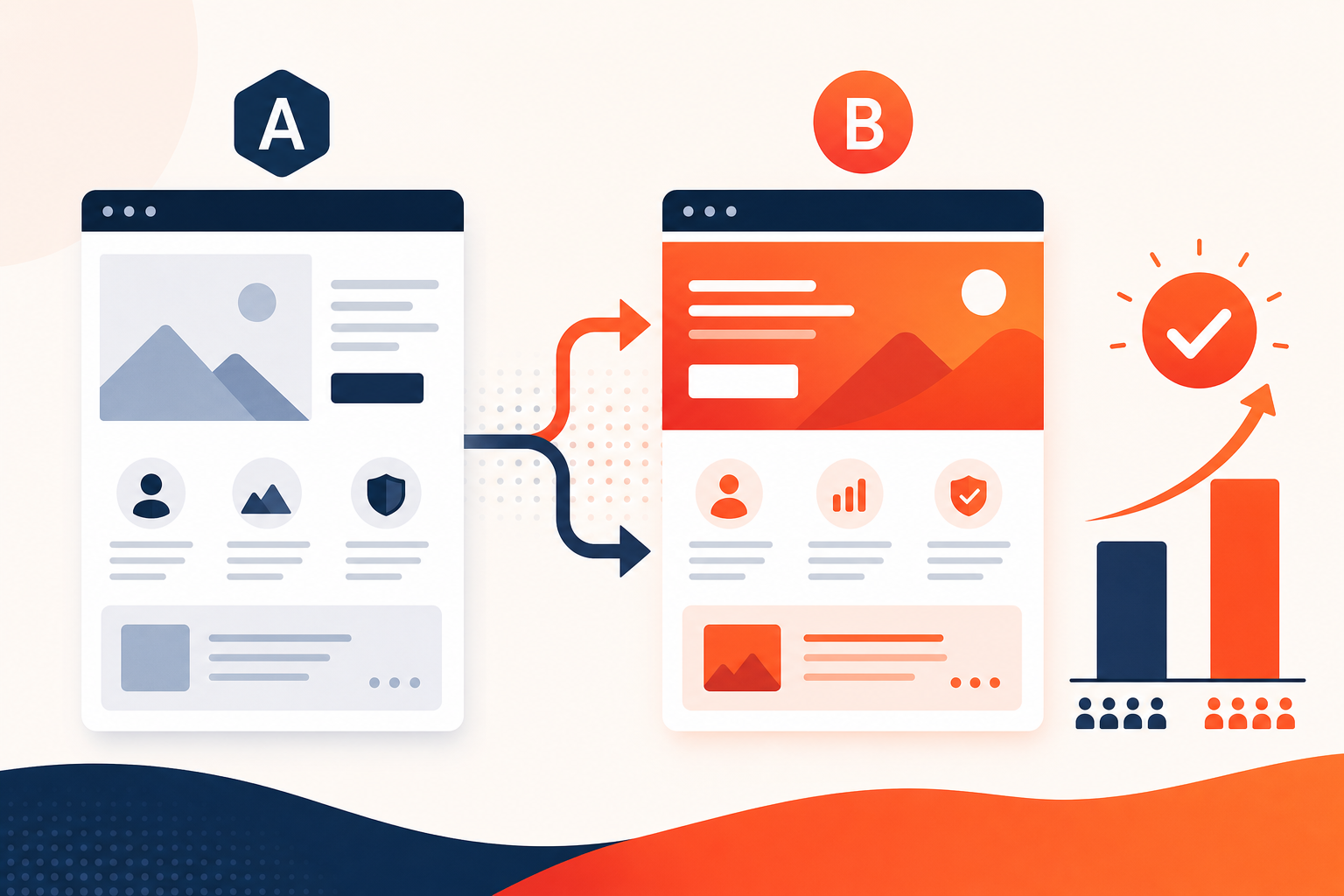
A/B testing is the backbone of CRO: you show version A (the control) to half your visitors and version B (the variation) to the other half, then measure which converts better. It replaces opinion with evidence — the loudest voice in the room no longer wins by default.
It is also easy to get wrong. A few guardrails keep your results honest:
- Test one clear hypothesis at a time so you know what caused any change.
- Reach statistical significance. Do not declare a winner after a day or a handful of conversions; small samples lie. Let the test run long enough to trust the result.
- Run for full business cycles. At least one to two weeks, so weekday and weekend behaviour both count.
- Watch for novelty effects. A new design can spike at first simply because it is new. Give it time to settle.
Google’s own guidance confirms that properly run A/B tests — including ones that temporarily show different content to different users — are a legitimate practice and will not harm your SEO when done correctly (Google Search Central, 2024).
High-Impact Changes to Test First
If you are not sure where to begin, these areas tend to move the needle most:
Your value proposition and headline
Visitors decide within seconds whether they are in the right place. A clear headline that states what you offer and why it matters often beats every button-colour test combined.
Calls to action
Test the wording, placement and prominence of your CTAs. Specific, benefit-led text (“Get my free quote”) usually outperforms vague labels (“Submit”).
Forms and friction
Every extra field costs you conversions. Ask only for what you truly need, and remove steps that make people hesitate. Long, intimidating forms are one of the most common leaks.
Trust signals
Reviews, testimonials, security badges, guarantees and clear contact details reassure hesitant buyers. Adding credible social proof near the point of decision frequently lifts conversions.
Page speed and mobile experience
A slow or clumsy mobile experience quietly kills conversions before any persuasion happens. This is where CRO and performance overlap — see our guide to Core Web Vitals for the technical side.
Common CRO Mistakes to Avoid
A few traps catch even experienced teams:
- Copying competitors blindly. What works for them may flop for your audience. Test it; do not assume it.
- Calling tests too early. Ending a test the moment it looks good is how you ship changes that quietly hurt you.
- Optimising trivia while ignoring the big stuff. Button shades rarely matter if your headline is confusing or your form is painful.
- Forgetting the post-click experience. Conversions depend on the whole journey, from ad to landing page to checkout, not one isolated screen.
- Treating CRO as one-and-done. Audiences, products and competitors change. The loop never really ends.
The teams that win at CRO are not the most creative — they are the most curious and the most disciplined about letting data settle the argument.
Frequently Asked Questions
What is conversion rate optimization (CRO)?
CRO is the systematic process of increasing the percentage of visitors who take a desired action — a purchase, form fill or sign-up — using data, research and testing to get more from the traffic you already have.
What is a good conversion rate?
It varies widely by industry, traffic source and goal. Many sites convert between 2 and 5 percent, but the most useful benchmark is your own trend. A good conversion rate is one that keeps improving against your baseline.
How is CRO different from SEO?
SEO brings more visitors; CRO helps more of them act once they arrive. They work best together — SEO grows the top of the funnel and CRO improves how efficiently that traffic becomes leads and sales.
How much traffic do I need to run A/B tests?
Enough to reach statistical significance in a reasonable time. Low-traffic sites can still do CRO through qualitative research, bigger bolder changes and longer test windows rather than tiny tweaks.
How long does CRO take to show results?
Individual tests typically run one to four weeks. The bigger compounding gains come over months as each cycle of research and testing teaches you more about your customers.
Get More From the Traffic You Already Have
Conversion rate optimization is how you stop leaving money on the table. Instead of constantly paying for more visitors, you make each one more likely to become a customer — a smarter, more durable way to grow. Start with research, test the big things first, and let the data lead.
Ready to turn more visitors into customers?
References
- CXL. “Conversion optimization statistics and benchmarks.” cxl.com, 2023.
- Google Search Central. “A/B testing and your website.” developers.google.com, 2024.